Minex Essentials for Exploration Geologists
From Field Data to 3D InsightBorehole data management, seam correlation, geological modelling, cross-section creation, seam layer prediction and resource evaluation.
We sell, implement and teach GEOVIA Minex — the geology and mine planning platform built specifically for coal and other stratified deposits.
Four holes. Thirteen faults. Four kilometres of section. One seam that still has to correlate across every block — and that is the work.
Dassault Systèmes has moved Minex onto a Continued Support footing. The product no longer appears on the current GEOVIA portfolio page, and the vendor’s own campaign describes the programme as supporting teams “as Minex full support concludes.”
Your seam models, wash curves and reserve statements do not expire when a support tier does. What matters is that someone in your organisation can still rebuild them.
That is the work: keep your licences current while they are available, get the models into a documented and scripted state, and train enough people that the platform decision stops being a single point of failure. We do all three.
Source: Minex Continued Support campaign, GEOVIA User Community, Dassault Systèmes. Quoted fragment used for factual reference.
Most coal operations do not fail at buying software. They fail at the eighteen months afterwards — when the model is half-migrated, the workflow is undocumented and the only person who understood it has resigned.
Getting the right seats, on the right terms, without paying for modules your team will never open.
From a raw borehole database to a signed-off seam model and a mine plan your board will accept.
Role-based curricula that leave your geologists and engineers genuinely independent of us.
Licensing, implementation and training are how we work. These are what the work is judged against — and both fail in the same place, where the technical study meets the economic one.
The reserve statement, the production plan and the waste movement all have to reconcile: with each other, and with last period’s realisation. What fails is rarely the geology. It is that the reserve number came from one place, the schedule from another, and the reconciliation was assembled in spreadsheets three weeks before submission.
Minex reports ROM, waste and strip ratio by block and period, off the seam model itself.
The resource has to be classified defensibly, the pit outline has to be the one the economics justify, and the schedule has to be achievable with the fleet and haul roads that exist. Studies come apart when those three were produced separately and reconciled only at the end. The reviewer finds the seam between them, and the study goes back for rework at the worst possible moment.
Minex tests every shell, and shows which one the economics actually justify.
Generic mining software treats a coal seam as an awkward special case. Minex treats stratigraphy as the starting point — which is why it handles splitting seams, reverse faults and washability curves that other packages simply cannot express. Twelve module families, from the first borehole import through underground panel layouts to spoil rehabilitation.
See Minex at work — 82 seconds
Module families by stage
Stores, analyses and interprets sampling and drilling data for coal and non-coal deposits, angled deviated holes included. A full database loads in minutes from ASCII, with automatic checks for out-of-sequence depths and out-of-limit values.
Completes every borehole stratigraphically so each seam carries an elevation and thickness, then uses the full sequence to build a gridded structural model of the deposit.
A standalone washability database holding every type of wash data, generating user-defined float/sink targets from the wash curve and transferring nominated results back into the borehole database for modelling.
Gridded models storing elevation, thickness or quality on a regular mesh, plus triangulated surfaces built from survey points to represent topography, pit shells and dump profiles.
Industry-standard estimators with a GSLIB interface for kriging and conditional simulation, variogram modelling with dynamic lag adjustment, and jack-knife validation of the result.
Finds the optimal outline among many feasible ones, then subdivides the economic mining area into benches, strips and blocks that mirror the intended technique and equipment. Block volumes land in an indexed reserves database keyed on pit, bench, strip, block and layer.
Two schedulers on one philosophy — start simple, then add detail. Target scheduling seeks a coal tonnage or volume across a period; detailed scheduling layers in the full operational picture.
Waste dump scenarios managed in a single interface, truck cycle time and utilisation analysis against an equipment database, haul road selection, and 3D playback of the result.
Design, reserves and scheduling for coal and other flat-lying tabular deposits. Quick Layout builds regular longwall or bord-and-pillar designs fast, and reusable panel libraries carry proven layouts into the next mine.
Patterns created and edited through a visual Blast Pattern Explorer — generate from imported points, extract top-of-coal data, design off collar or toe surfaces, and flag holes whose front burden falls below the minimum.
GPS and raw field survey reduced to X,Y,Z through the Survey Book, driving surface generation and volumetrics. Spoil Regrade then produces an optimum regraded landform by minimising how far and how much waste has to be pushed.
SQL scripts run against the borehole database, grid models, and both the open cut and underground reserves databases. Tcl macros turn the repeatable parts of the monthly cycle into something anyone on the team can rerun.
Three schematics of what Minex is asked to produce — a faulted multi-seam model, a pit and dump with the route between them, and reserve blocks coloured by mining period. Drawn by MinexCoal to show the shape of the output.
Three seams carried across two faults that step the whole sequence up to the right, with boreholes tying every intersection back to the model — the geometry generic packages struggle to represent.
Minex carries one seam across every fault block, and holds the correlation.
Pit benches, the ramp out, the dump building in lifts and the route between them in one scene — driving truck cycle time and haul road selection instead of a spreadsheet estimate.
Minex times the haul before a single truck moves.
The deposit subdivided into mining volumes by bench, strip and block, colour-coded by schedule period and, in Minex itself, playable as an animation.
Minex reports the reserve block by block, period by period.
A reserve statement is only as defensible as the path back to the borehole it came from. That path is what we build.
Three people will pull on that path, and none of them are you: the Competent Person who signs the estimate, the reviewer who reads the RKAB, and whoever the parent company sends when the numbers move. What they ask for is not the model. It is the reason the model says what it says — the variance grid, the variogram, the QA/QC record, the reconciliation against last period.
A model that cannot produce those is not wrong. It is just undefendable, and that costs the same.
Where this gets decided: JORC, SNI & RKAB reporting · Risk & Assurance
A deposit has a life. It begins as numbers in a drill log, becomes a seam model, then a resource someone signs their name against, then a pit worth opening, a schedule, a fleet of trucks — and it ends as a landform that outlives the mine. These eighteen follow that arc, in order. The last four sit outside it because they belong to every stage. Eleven come from the Minex Continued Support programme; the other seven are ours, because that programme covers no mine engineering at all.

Borehole data management, seam correlation, geological modelling, cross-section creation, seam layer prediction and resource evaluation.

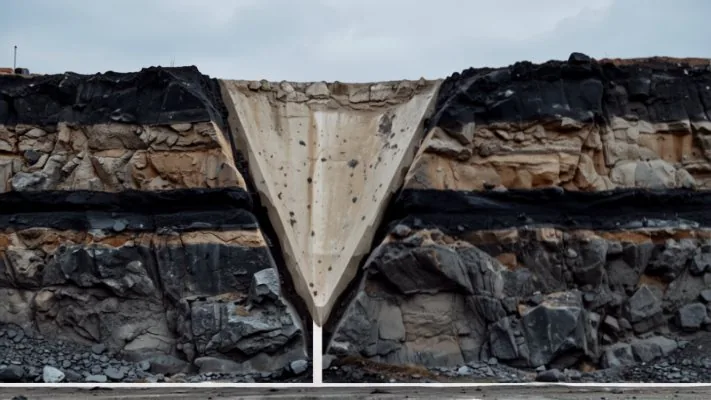
Turning raw, messy inputs into clean and trusted datasets — borehole data, geometry files and survey surfaces, validated and structured.

Practical techniques for turning difficult borehole data into confident seam models when the geology refuses to cooperate.

The two primary modelling pathways in Minex, when each one produces the more robust result, and how to apply both with confidence.

Fault interpretation from seismic sections and contour plans, zero-throw faults, structural regimes, 2D and advanced 3D fault modelling.

Assessing data integrity, applying QA/QC principles, generating reliable grids and surfaces, and evaluating model performance.

Experimental variograms across four orientations, model fitting with spherical, exponential, Gaussian and hole-effect structures, and a variogram map that exposes the direction of maximum continuity. Kriging then writes back a variance grid holding the 95% confidence range, plus sample count and average sample distance grids — the three spatial measures a Measured, Indicated or Inferred boundary has to be argued from. Jack-knifing closes the loop against the holes themselves. How this supports JORC, SNI and RKAB.

The complete reporting workflow — validating input datasets through to tonnage, density, quality and classification outputs that survive audit.

An optimal outline is the one where nothing can be added or removed without either breaking the safe slope constraint or losing dollar value. Covers the three pricing modes, the structural and quality grids the optimiser demands, breakeven strip ratio, and how to read the run log when it fails.

The five design modes — Boundary, Strip, Block, Free and Part Boundary — and how they subdivide an economic mining area into benches, strips and blocks that mirror the technique and equipment you actually run. Block layout patterns, generation, validation and ramp editing included.

The reserves database keyed on pit, bench, strip, block and layer, and the three reports it produces: Status/Null for total waste and coal volumes, Reserves DB for quality variable volumes with full control over what gets reported, and List Layers. Reserves after design — a different discipline from the resource reporting workshop.

Target scheduling seeks a coal tonnage or volume across a period; detailed scheduling adds the operational picture. Then Scenario Manager for the routes linking pits, dumps, waste piles and washeries, and the constraints governing where and when material can be placed and how each dump fills.

The complete cycle from pit, waste pile or washery to dump and back, broken into spot time at the loader, load time assembled from scoop, swing and dump-into-truck components, travel across haul roads and ramps, unload at the dump, and queueing. Ramp Distance Generator supplies distance and grade from each block centroid; Haulage Selection then reports how many trucks hold each loader at capacity, ranked by distance, time, truck count or operating cost.

Spoil Regrade computes the optimum regraded landform by minimising how much waste is pushed and how far, confined inside boundary and drainage strings that define the rehabilitation limit, then plots material movement cell by cell. EarthWorks adds the sectional side: cut/fill balance against a template profile, Max Spoil for dump progression from a toe polygon, and Drag Spoil for dragline landforms.

Sections, plans, grids and heat maps with corporate-standard styling, symbology and layout control for reports and stakeholder briefings.

Shortcuts and best-practice workflows for managing borehole data, improving seam correlations and refining models faster.

SQL macros and Minex-specific syntax applied across borehole, seam and grid datasets to automate interrogation and deepen analysis.

Recording and modifying macros, defining variables, applying flow control, and working with lists, procedures and file input/output.
A typical deployment takes eight to sixteen weeks depending on how much historical data has to be reconciled.
A typical rollout, week by week
We audit your existing data, current software, reporting obligations and the gap between what your team can do today and what the plan requires.
Borehole databases are connected and validated. Legacy grids and seam models are brought across, then reconciled against your last signed reserve statement.
Seam and quality models are rebuilt, faults defined, and the monthly cycle is scripted so the same result is reproducible by anyone on the team.
Role-based training on the delivered project, written procedures, competency sign-off and a support arrangement sized to how much you still need us.
If the honest answer is that you do not need us, that is the answer you will get. It has cost us work. It has never cost us a client.
Minex is a narrow, deep product. It rewards people who have spent years inside it and punishes people who have read the manual.
Yes — under Continued Support. The current line is actively maintained, with recent point releases carrying documented enhancements across Open Pit, Seam Modelling, Core and Borehole, and Dassault Systèmes is running a full eleven-workshop programme from March 2026 through January 2027. Anyone still on an older branch is running behind the current line. The vendor’s own campaign frames this as support for teams as Minex full support concludes, so treat it as a mature platform in managed transition rather than one under active feature development. Minex also no longer appears on the current GEOVIA portfolio page. None of that changes why you chose it — splitting seams, reverse faults and washability curves that generic packages cannot express. It just means the roadmap needs planning instead of assuming.
Attend them — they are good, and we will tell you which ones matter for your roles. But a six-hour regional webinar teaches the tool on the presenter’s dataset, at a fixed time, to whoever can attend. It does not migrate your Vulcan grids, reconcile last year’s reserve statement, script your monthly cycle, or sit with your geologist when a seam split refuses to model. That is the gap we fill, and it is the reason the two are complements rather than alternatives.
Not automatically. Surpac is the stronger choice for massive and vein deposits, but it does not replicate the stratigraphic and washability depth that makes Minex worth using on coal. Where a migration does make sense, established workflows exist for moving stratified and quality models from Minex into Surpac, and we will scope that honestly rather than sell you a project you do not need.
Yes. Minex supports import and export of Vulcan and Carlson grid files and seam models, and string data exchange with AutoCAD. Reconciling that data against your last reported reserves is normally the largest single task in a migration, and we budget for it explicitly.
Yours, wherever the commercial terms allow it. Sample-data training consistently fails to transfer. If confidentiality prevents it, we build an anonymised dataset that preserves your actual seam geometry and quality characteristics.
You should need us less over time — that is the point of the training tracks. We offer a retained support arrangement for model reviews, scripting changes and cover during staff turnover, sized to your actual usage rather than a fixed annual block.
The more we know about your seam structure, data history and reporting obligations, the more useful our first reply will be.